Barcode Interpretation for Electrofusion Poly Welding

This morning, we received an urgent call from a customer out on site who wanted to double-check the weld time for electrofusion poly welding a 63mm socket. He was surprised to learn that it only takes 65-70 seconds. It’s best to double-check, we say, so off we went to the warehouse to check an EF socket on the shelf. Sure enough, 65 seconds is all it requires.
Of course, this varies for different-sized sockets. So, the best way to check is the barcode of the EF fitting itself, which follows the manufacturer’s recommendation and the electrofusion welding procedure set by ISO 13950.
How to read an electrofusion poly welding fitting barcode
The barcode has 24 numbers, most of which you can interpret by using an industry-wide method.
Numbers:
- 1-8 = Manufacturers mark
- 9-11 = Dimension (eg 63mm)
- 13-14 = Fusion current in voltage
- 16-18 = Electrical resistance in ohms
- 19-21 = Fusion time in seconds
- CT = Cooling Time
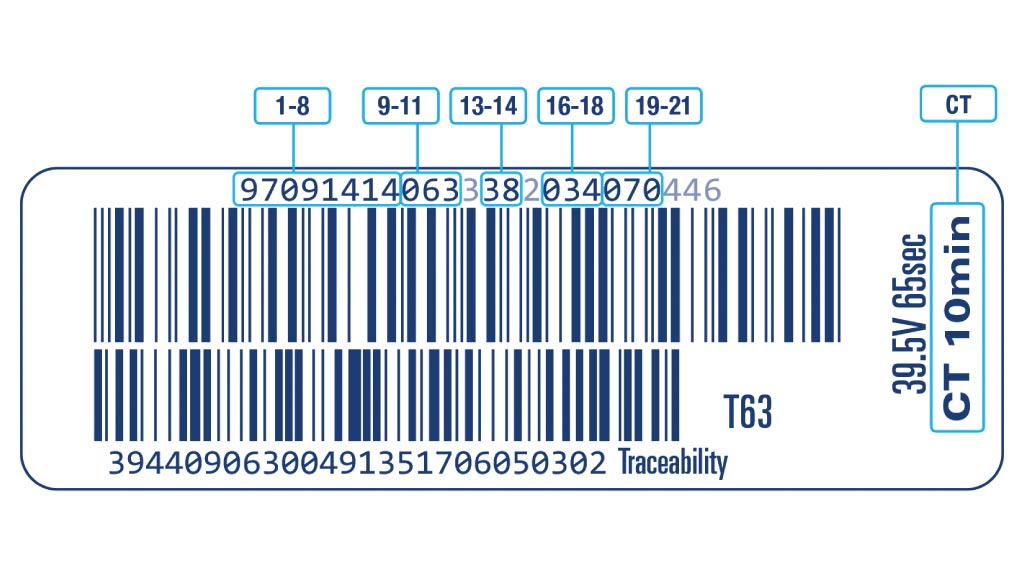
Watch our electrofusion welding demonstration to see the barcode scanned during a live weld. Or call us for a full production information sheet.
Typical electrofusion weld times by size
This is a general reference only. Always scan the barcode on the fitting itself, that’s the authoritative source and follows the manufacturer’s exact specification for that batch.
|
EF fitting size |
Typical fusion time |
Typical cooling time |
|
25 mm |
25–35 seconds |
5–10 minutes |
|
32 mm |
30–40 seconds |
10 minutes |
|
50 mm |
45–55 seconds |
15 minutes |
|
63 mm |
65–70 seconds |
20 minutes |
|
90 mm |
90–110 seconds |
25 minutes |
|
110 mm |
120–140 seconds |
30 minutes |
Times shown are indicative for standard PE100 electrofusion couplers and vary by manufacturer, ambient temperature, and fitting type (coupler vs socket vs branch saddle). The barcode is always the correct reference.
The Purpose of a Barcode
In Electrofusion poly welding, you must strictly follow Electrofusion (EF) welding parameters to ensure a successful joint.
|
Feature |
Manual EF welding |
Automatic EF welding (barcode scan) |
|
Data entry |
Manual, operator enters parameters |
Automatic, barcode scanner reads the fitting |
|
Source of data |
Manufacturer’s instructions, checked by operator |
Barcode on the fitting, following ISO 13950 |
|
Risk of parameter error |
Higher, operator can input wrong voltage, time, or dimension |
Very low, parameters locked to the specific fitting |
|
Traceability |
Depends on manual record-keeping |
Data logged automatically by the control unit |
|
Best for |
Backup / emergency where barcode is damaged |
Standard production welding (all routine jobs) |
Control units should operate with barcode marked fittings according to ISO 13950, with a maximum output of 48 volts. Control units should include safety devices to prevent voltages greater than recommended by the manufacturer. The safety device should operate in less than 0.5 seconds. The user should check the suitability of the control unit for use with the fitting supplier. (REF: PIPA Recommendations for Electrofusion Welding Specifications)
Looking for an electrofusion welder? Browse the APS electrofusion welding machine range.

