How to Select the Best Municipal Water Piping System in Australia
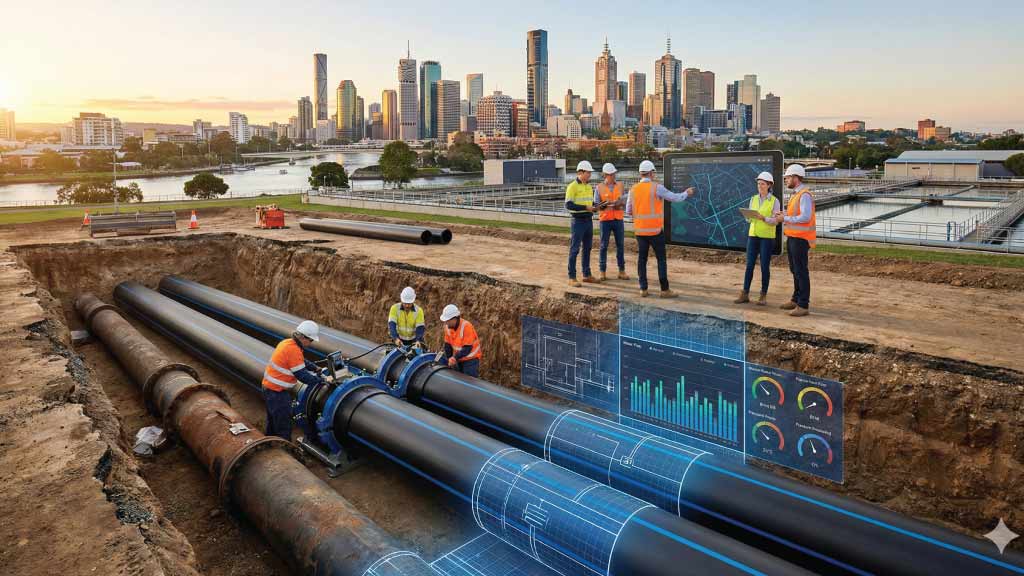
Municipal Water Piping Systems: An Engineer’s Guide to Material Selection
Municipal water piping systems are the backbone of our urban infrastructure, ensuring that potable water is delivered efficiently to Australian households and businesses.
For civil engineers and project managers, selecting the right piping material is no longer just about pressure ratings; it’s about Total Cost of Ownership (TCO), environmental sustainability, and compliance with strict Australian Standards.
This guide explores the crucial considerations for selecting the right systems for your next municipal project, with a focus on the shift toward modern materials such as PE100 (HDPE).
1. Defining Project Needs: Quality & Pressure
Understanding Water Quality & Biofilm
One of the foremost considerations is maintaining the quality of the water being supplied. In Australia, where water hardness and salinity vary wildly between states, the pipe material must be inert.
- Corrosion Risk: Metallic pipes (like Ductile Iron) can suffer from tuberculation, reducing flow rates over time.
- Biofilm: Materials like PVC can be susceptible to biofilm accumulation. Smoother, fusion-bonded materials like HDPE (Poly Pipe) offer a seamless internal bore that resists bacterial growth and maintains water purity.
Assessing Pressure Demands & Surges
Municipal water piping systems must handle varying pressure demands, from elevation changes to pump surges (water hammer).
- Static Pressure: The pipe must handle the standard operating pressure (PN rating).
- Surge Events: Events like valve closures create pressure spikes. Engineers should use hydraulic modelling to ensure the selected piping – especially its joints – can withstand these surges.
**Tip: Electrofusion and Butt Fusion joints create a continuous system that is far more resistant to water hammer than rubber-ring jointed pipes.
2. Material Comparison: The “Big 3”
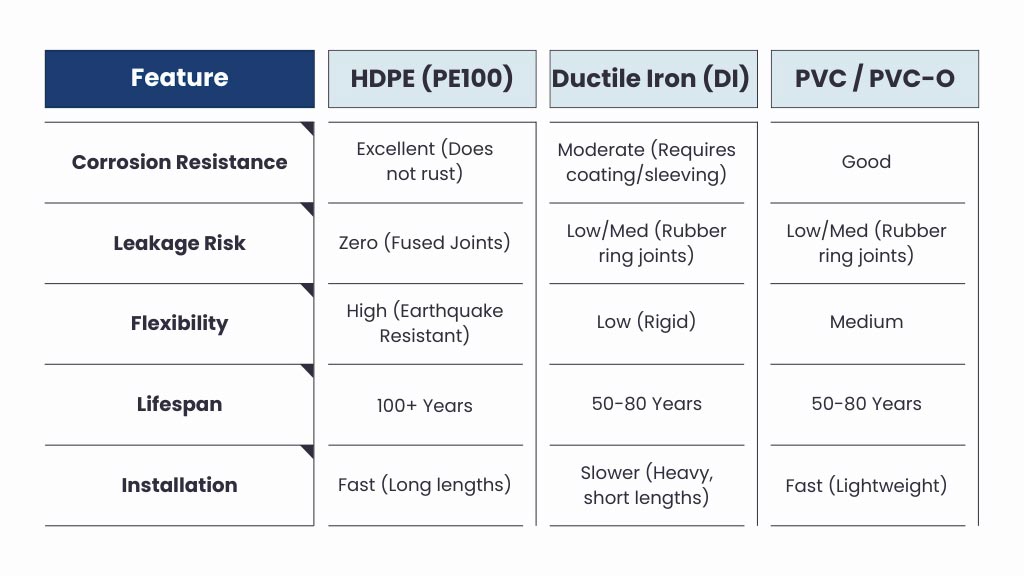
Choosing between traditional and modern materials is the biggest decision for any council or utility. See the comparison below for a quick snapshot.
Why Lifecycle Cost Analysis Matters
While PVC or DI might appear cheaper on a “per metre” basis initially, the Lifecycle Cost often favours Polyethylene.
- Leakage: Studies show fused PE systems have significantly lower leakage rates than mechanical joint systems.
- Maintenance: HDPE requires zero cathodic protection and does not rust, reducing OPEX (Operational Expenditure) for the municipality.
3. Environmental & Installation Context
Soil Conditions and Salinity
Australia has some of the most corrosive soils in the world.
- Saline Environments: For coastal councils or high-salinity soil areas, HDPE fittings are superior as they are immune to electrochemical corrosion.
- Seismic Activity & Ground Movement: Rigid pipes (Concrete/Iron) are prone to cracking during ground movement. Flexible PE piping moves with the ground, making it the standard choice for “trenchless” installations and unstable reactive clay soils.
Ease of Installation
Installation speed drives project cost.
- Weight: HDPE is lightweight, reducing the need for heavy lifting machinery.
- Trenchless Technology: Can be installed via Directional Drilling (HDD), avoiding road closures and minimising disruption to the community.
4. Compliance: Australian Standards (WSAA)
You cannot design a system in Australia without strict adherence to the Water Services Association of Australia (WSAA) codes and AS/NZS Standards.
Ensure your chosen materials meet the following:
- AS/NZS 4130: Polyethylene (PE) pipes for pressure applications.
- AS/NZS 4129: Fittings for polyethylene (PE) pipes.
- WSAA Codes: The “Water Supply Code of Australia” sets the benchmark for design and installation.
At Advanced Piping Systems, all our municipal piping products are rigorously tested to meet or exceed these Australian requirements.
5. Planning for Future Growth
Expansion & Modularity
Municipalities must plan for population growth.
- Oversizing: Designing for 2050 often means selecting larger-bore pipes today.
- Hot Tapping: Modern electrofusion technology enables “Live Tapping” (adding a new branch line without shutting off the water). Our Tapping Saddles are designed specifically for this, allowing councils to expand networks with zero downtime.
6. Selecting a Trusted Partner
It is not just about buying pipe; it’s about technical support.
- Reliability: Does your supplier stock critical repair parts, such as Electrofusion Couplers, for emergency breaks?
- Customisation: Can they fabricate a specific manifold or spool if your site has unique constraints?
At Advanced Piping Systems, we specialise in supporting civil contractors and water authorities with high-stock availability and technical fabrication services.
Give us a try with your next project – contact our friendly team here.
FAQ: Municipal Water Piping Systems
What is the best material for municipal water piping systems in Australia?
While Ductile Iron and PVC are common, HDPE (PE100) is increasingly the preferred choice due to its leak-free fused joints, 100-year lifespan, and resistance to Australian soil conditions.
How do I ensure my piping is WSAA compliant?
Always request compliance certificates from your supplier. Ensure pipes are manufactured to AS/NZS 4130 and fittings to AS/NZS 4129.
Can HDPE pipe be used for high-pressure water mains?
Yes. High-performance PE100 pipe can be rated up to PN25 (25 Bar), making it suitable for most municipal pressure mains and pumping lines.

