A Comparative Analysis of GRP and HDPE
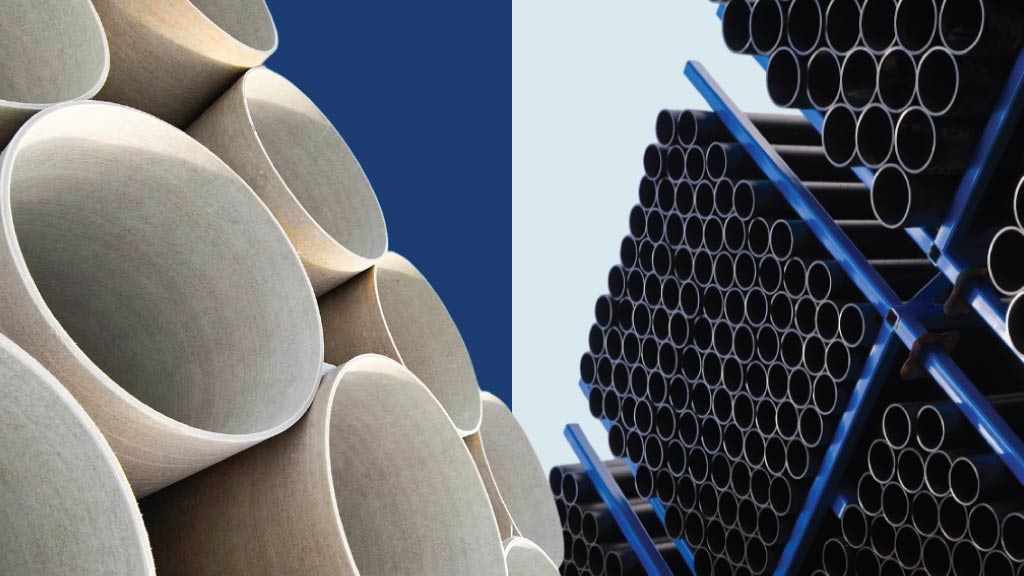
When it comes to selecting materials for various applications, Glass Reinforced Plastic (GRP) and High-Density Polyethylene (HDPE) often emerge as popular choices. Each material’s unique benefits and features make it suitable for specific applications. In this article, we will explore the advantages of both GRP and HDPE, compare their key features, and provide examples of when one material might be preferred over the other.
What is a GRP pipe?
GRP (Glass Reinforced Plastic) pipe is a composite material made from glass fibres set in a thermosetting resin matrix. The glass reinforcement gives it tensile strength, while the resin provides corrosion resistance and shape. GRP pipes are typically used in water transmission, sewerage, and industrial process applications where corrosion resistance and large diameters matter.
HDPE (High-Density Polyethylene) pipe is a thermoplastic polymer, a single homogeneous material that can be fully welded into leak-proof systems. HDPE is widely used in mining, civil infrastructure, water and gas distribution, and chemical handling.
The rest of this article compares the two in detail.
Not Sure What’s the Difference Between GRP and HDPE?
Benefits of HDPE:
HDPE, a durable thermoplastic polymer, offers a range of advantages:
- Chemical resistance: HDPE possesses exceptional resistance to a wide range of chemicals, including acids, alkalis, and solvents. This property makes HDPE an excellent choice for applications in the chemical processing industry, waste management, containment systems, and water treatment.
- Impact resistance: HDPE is highly resistant to impact, making it a suitable material for applications that require strength and durability and will withstand vibration and movement, water hammer in applications such as pipes piping, packaging, chemical and water storage and tank farms, Safety Guards on industrial processing equipment materials, XDam liners and Geomembranes
- UV resistance: HDPE has inherent UV resistance, making it an ideal material for outdoor applications. It can withstand prolonged exposure to sunlight without degradation, making it suitable for items like outdoor furniture, pipes, and plastic lumber.
- Leak-proof system: For piping systems, HDPE does not rely on glue or resin binder; instead, HDPE is fully weldable, providing a homogeneous, leak-proof system.
- Flexibility: HDPE exhibits excellent flexibility, allowing it to be easily moulded and extruded into pipes. This feature makes HDPE suitable for applications that require flexibility, such as above-ground systems, chemical drainage pipes, and geomembranes.
- Durability: 50–100-year design life under normal conditions, with 100+ years achievable in municipal water applications (per Plastic Pipe Institute research).
- Efficiency: HDPE piping systems provide energy-saving benefits attributed to their smooth interior and exterior surfaces. The smooth coefficient of the inner surface reduces friction loss, resulting in improved energy efficiency. Additionally, the smoothness of the HDPE pipes minimises noise (dB) and turbulence, further enhancing the overall system performance.
- Safety: HDPE piping provides a safe, easy-to-handle system and won’t degrade, crack or delaminate over time due to UV exposure.
- Impact resistance: HDPE handles impact, vibration, movement and water hammer well. This makes it suitable for piping systems, chemical and water storage tanks, tank farms, safety guards on industrial equipment, dam liners and geomembranes.
Appropriate applications of HDPE
HDPE is widely used in various industries, including chemical processing, water treatment, desalination, packaging, construction, and agriculture. It is employed in the production of pipes, chemical storage tanks, packaging containers, geomembranes for environmental protection, water treatment piping systems, sewerage and desalination systems, agricultural drainage systems, and civil piping systems.
Benefits of GRP (Glass Reinforced Pipe)
- High Strength-to-Weight Ratio: GRP exhibits exceptional strength while maintaining a low weight. This characteristic makes it suitable for applications where a lightweight material with high strength is essential, such as aerospace components, boat hulls, and sports equipment.
- GRP’s High Temperature Rating: due to its semi-crystalline structure, which provides thermal stability and resistance to heat. With a relatively high melting point, typically ranging from around 120°C to 130°C (248°F to 266°F), GRP can withstand elevated temperatures without significant deformation or degradation. Its good heat resistance and low thermal conductivity allow HDPE to maintain its dimensional stability and mechanical strength even when exposed to high temperatures, making it suitable for applications requiring reliable performance in hot environments.
- Corrosion Resistance: GRP is highly resistant to corrosion from various substances, including chemicals, moisture, and atmospheric agents. This resistance to corrosion makes GRP ideal for applications exposed to harsh environments, such as chemical processing plants, offshore structures, and water treatment facilities.
- Design Flexibility: GRP can be easily moulded into complex shapes and forms, providing designers and engineers with greater flexibility in realising their creative visions. This feature allows for the production of customised components, architectural structures, and artistic installations.
- Electrical and Thermal Insulation: GRP exhibits excellent electrical and thermal insulation properties, making it suitable for applications where these characteristics are critical, such as electrical enclosures, insulation panels, and cooling towers.
Appropriate Applications for GRP
GRP is commonly used in industries such as aerospace, marine, construction, and automotive, where its high strength-to-weight ratio and corrosion resistance are advantageous. Examples include aircraft components, boat hulls, architectural features, and automotive body panels.
GRP and HDPE are both versatile materials that offer unique benefits and features, making them suitable for a wide range of applications. GRP’s high strength-to-weight ratio, corrosion resistance, and design flexibility make it an excellent choice for aerospace, marine, and architectural applications.
On the other hand, HDPE’s chemical resistance, impact resistance, UV resistance, and flexibility make it a preferable choice for applications in chemical processing, water treatment, sewage, desalination piping systems, and the agricultural sector. Ultimately, the selection between GRP and HDPE depends on the specific requirements of the application at hand, including the environmental conditions, required strength, and desired characteristics.
| Characteristic | HDPE (PE100) | GRP |
| Material type | Thermoplastic polymer — homogeneous, single-material | Composite — glass fibres in thermosetting resin matrix |
| Standards (Australia) | AS/NZS 4130 (pipe), AS/NZS 4129 (fittings), AS/NZS 4020 (potable water) | AWWA M45, ISO 14692, ISO 10639, WSAA appraisals |
| Typical pressure range | PN6 to PN25 (PE100), with PN10–PN16 most common in water | PN6 to PN16 standard; PN25–PN32 available in higher specs |
| Diameter range | DN20 to DN1600+ | DN100 to DN3000+ (excels at large diameters) |
| Design life | 50–100 years (100+ in municipal water) | 50+ years, dependent on resin and exposure |
| Jointing methods | Butt fusion, electrofusion, compression, flanged (stub flange + backing ring) | Bell and spigot with elastomeric seals, laminated, flanged |
| On-site modification | Easy — butt fusion, electrofusion, compression, all field-friendly | Difficult — requires laminating or specialist jointing |
| Weight (relative) | Light — approx. 950 kg/m³ density | Lighter than ductile iron, heavier than HDPE |
| Chemical resistance | Excellent across acids, alkalis, solvents | Good, but certain resins react with chlorine dioxide and ozone |
| UV resistance | Inherent (carbon black HDPE) | Requires UV-protective topcoat |
| Corrosion resistance | Immune — does not corrode | Excellent — does not corrode |
| Abrasion resistance | Excellent — widely used for above-ground tailings | Lower than HDPE for slurry applications |
| Leak path | Fully welded, homogeneous, leak-proof joints | Sealed joints — rely on gaskets or laminate |
| Ageing behaviour | Stable; no degradation under UV or chemical exposure | Resin binder can break down over time, exposing glass fibres (a safety hazard) |
| Cost (relative) | Generally lower | Generally higher, especially in smaller diameters |
How to Identify the Reasons Why GRP is Not Preferred
While GRP offers numerous benefits, there are specific reasons why it might not be the preferred choice for water treatment applications, such as water storage and containment. Here are a few factors that might influence the decision not to use GRP in this context:
- Water permeability: Compared to HDPE, GRP may have higher water permeability, which means there is a greater chance of water slowly seeping through the material. In water treatment applications, maintaining containment and preventing any leakage or contamination of the treated water is crucial. HDPE’s lower permeability makes it a more suitable choice for water storage and containment, reducing the risk of water loss or intrusion.
- Chemical compatibility: While GRP is generally resistant to a range of chemicals, certain chemicals used in water treatment processes, such as chlorine dioxide and ozone, can potentially degrade or react with the resins used in GRP. HDPE, on the other hand, has better chemical resistance and can withstand exposure to a wider range of water treatment chemicals, ensuring the material remains stable over time.
- Structural considerations: GRP is known for its high strength-to-weight ratio, which is advantageous in various applications. However, for water storage and containment where large volumes of water need to be held, the material’s structural properties become a critical factor. HDPE is better suited for these applications, as it can provide the required structural integrity and strength necessary to withstand the weight and pressure of the water without compromising its performance.
- Installation: While both are available as prefabricated Systems, HDPE has the benefit of not having fixed flanges and is standardly supplied with slip-on ring flanges, which are significantly easier to install and offer greater flexibility.
- Modification: HDPE offers the ability to modify on-site with easy-to-use electrofusion, butt welding and compression (slide and tighten) options.
- Cost: While cost may vary depending on factors such as project size and location, HDPE is generally considered a more cost-effective option compared to GRP. This cost advantage can be a significant consideration, particularly for large-scale water treatment projects where cost efficiency is prioritised.
- Safety: Aged GRP becomes a safety hazard due to the binder resin breaking down and leaving exposed glass fibres, which makes it challenging to work with.
HDPE comes out on top
Considering the factors mentioned above, such as water permeability, chemical compatibility, structural considerations, Installation ease, cost and ability for quick on-site modification, HDPE emerges as the preferred choice for water treatment applications, including water treatment, storage, desalination and containment. Water treatment companies choose to use HDPE as it aligns with these factors, enabling them to provide reliable and efficient water treatment solutions to their clients while ensuring the necessary performance, durability, cost-effectiveness and minimal environmental impact.
For more information, or if you need support with your next piping systems project, give us a call at 1300 362 229 or contact us via the website today!

