Can You Glue HDPE Pipe?
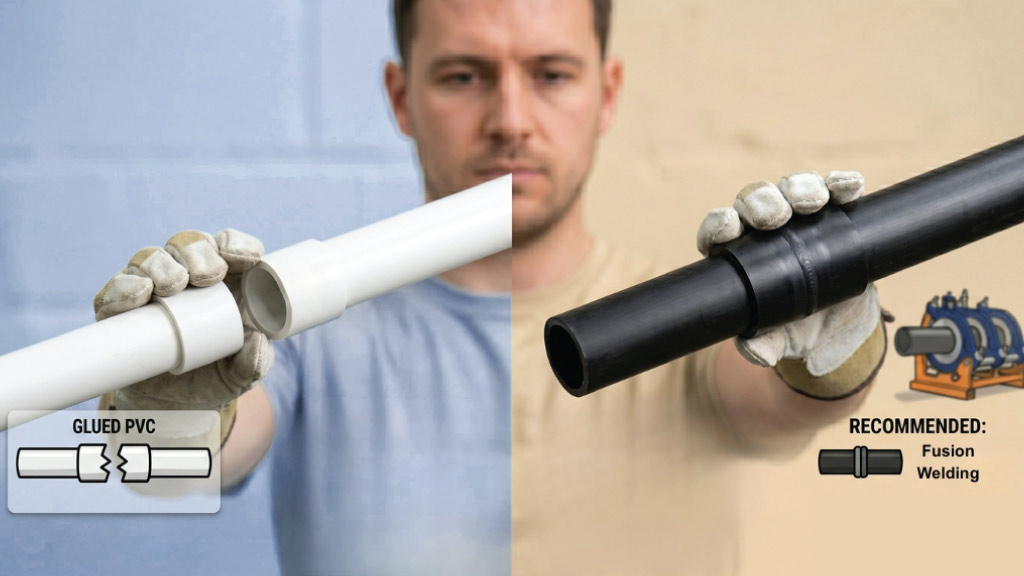
Can You Glue HDPE Pipe Like PVC? The Honest Answer
A question came through on one of our LinkedIn posts recently from a water-treatment professional who works hands-on with piping every day. It was an honest one, and a good one: are there street fittings and solvent glue for HDPE, the same way there are for PVC and CPVC? Can you just cut, socket and glue it?
So, can you glue HDPE pipe like PVC? It’s worth answering properly, because a lot of people who are comfortable with PVC ask exactly the same thing when they move to HDPE (poly) pipe for the first time. The short version: no, and the reason why is the single most important thing to understand before you specify or install a poly system.
The short answer to “Can you glue HDPE pipe?” is no.
HDPE (high-density polyethylene) is what materials scientists call a low surface energy plastic. Its surface is chemically inert and non-porous, which is exactly what makes it so brilliant at resisting corrosion, chemicals and abrasion, and exactly what stops ordinary adhesives from getting a grip. A solvent cement works on PVC because it chemically softens and welds the two surfaces together. Poured onto HDPE, that same solvent simply has nothing to bite into.
So the socket-and-glue approach that’s second nature with PVC or CPVC doesn’t translate. Instead, HDPE is joined by heat fusion, where the pipe is melted and fused back into a single, continuous piece of material. Done correctly, the join isn’t a weak point bolted onto the pipeline; it effectively becomes the pipeline.
As Nathan Craig, CEO of Advanced Piping Systems, put it when this exact question came up:
“Butt or electrofusion is the only fail-safe way to join HDPE piping. This provides a consistent joint that’s as strong as the parent pipe material. In destructive pressure testing, we see the pipe fail before the welded joint does. I can’t imagine that being the case with a PVC glued joint.”
That last point is the one to sit with. When a properly fused poly joint is tested to destruction, it isn’t the joint that gives way. The pipe lets go first.
How HDPE is actually joined
There are two methods you’ll use for the vast majority of pressure applications: water, gas, mining, irrigation and industrial process lines.
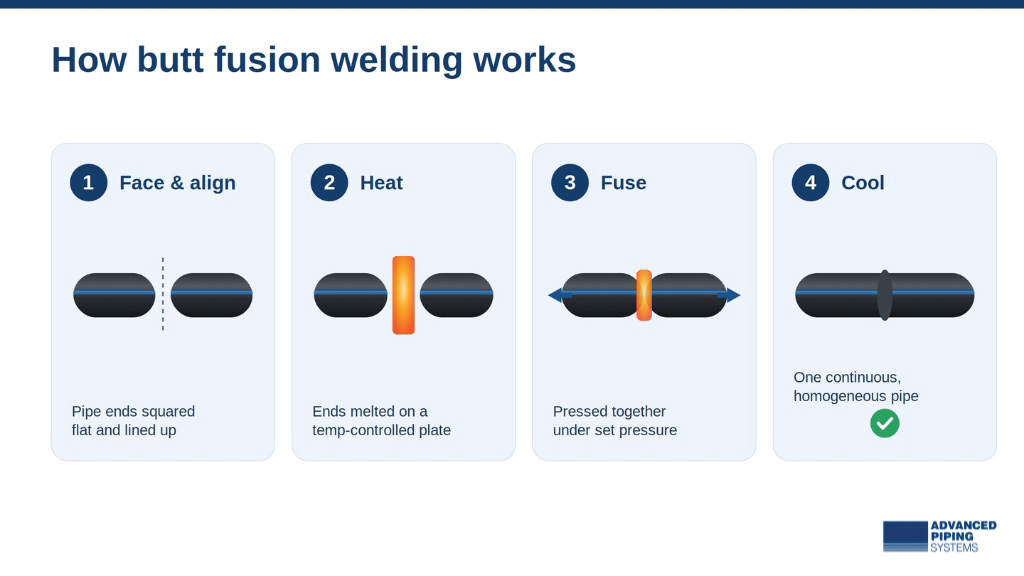
Butt fusion welding
The squared ends of two pipes (of the same diameter, wall thickness and material grade) are faced flat, heated against a temperature-controlled plate, then pressed together under controlled pressure and allowed to cool. The result is a uniform joint with no filler, no solvent and no mechanical fitting, just one length of pipe where there used to be two. Because the joint resists end-load in its own right, you generally don’t need thrust blocks at bends, tees or valves. Butt fusion is the workhorse for joining straight runs from roughly 90 mm upwards.
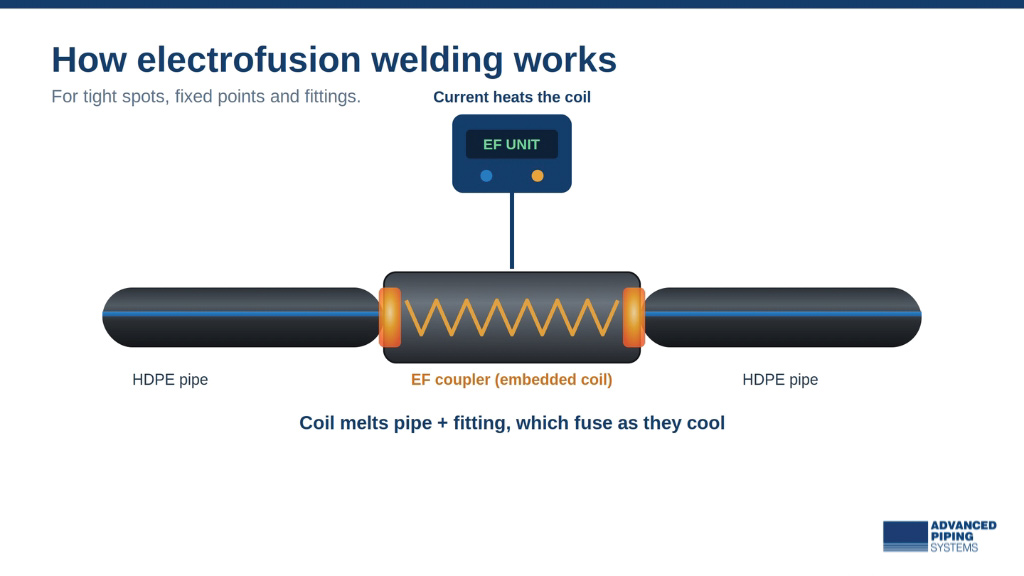
Electrofusion welding
Here a purpose-made fitting with an embedded heating coil is fitted over the prepared pipe ends. A current is passed through the coil, melting the inner surface of the fitting and the outer surface of the pipe so they fuse together as the material cools. Electrofusion comes into its own where a butt welder physically can’t be used, such as joining to fixed points, working in tight trenches, overhead, or on smaller diameters. It’s the method of choice for fittings such as couplers, elbows, tees and saddles.
(Socket fusion and saddle fusion exist too, typically for smaller diameters and branch connections, but butt and electrofusion are what you’ll specify most of the time.)
A practical note that surprises people coming from PVC: a fused joint is only as good as the preparation and the parameters behind it. Clean, oxide-free surfaces, the right temperature, the right time, the right pressure, and accredited operators are what separate a joint stronger than the pipe from one that fails in service. Our expert’s guide to welding poly pipe and electrofusion jointing guide walk through getting both right.
Why a fused joint beats a glued one
It’s not that PVC’s solvent-welded joints are bad. They’re well understood and perfectly suited to plenty of applications. The difference is structural:
- It’s consistent. A fused poly joint is the same material, fully merged, with no interface that can be the weak link. A glued joint is two parts held together by an adhesive layer between them.
- It resists end-load. Because the joint carries load like the parent pipe, fully end-load-resistant fusion welds remove the need for thrust restraint in many designs, saving cost and installation time.
- It’s built for the long haul. PE100 systems are designed for service lives well beyond 50 years. A quality fusion weld is engineered to match that; it isn’t a consumable seal that degrades on a different timeline to the pipe around it.
“But I’ve seen HDPE glue advertised…”
You have, and it’s worth being straight about it. There are specialty adhesives (modified acrylics and primer-activated products) formulated to bond low-surface-energy plastics like HDPE. They have a genuine place: small repairs, bonding HDPE to dissimilar materials, sealing applications.
What they’re not is a substitute for fusion on a pressurised pipeline. Even a well-made chemical bond struggles to withstand the sustained internal pressure and end-load a working main sees every day. If the system needs to hold pressure and last decades, the answer is fusion, not glue.
What about connecting HDPE to existing PVC or other pipe?
This is the real-world version of the question, and it comes up constantly on retrofit and repair work: you’ve got HDPE on one side and PVC, ductile iron, copper, AC or steel on the other. You can’t fuse two different materials together, and you can’t reliably glue them either.
The clean solution is a mechanical adaption fitting. Our Universal Adaption Joint (UAJ) is made specifically for this. It adapts and seals HDPE to PVC, cast or ductile iron, asbestos cement, copper and other materials, with long spigots that butt or electrofusion weld straight onto your poly side. Unlike traditional bolted couplers that can work loose over time, it’s designed to stay put and stay sealed, and it’s been proven on some of Australia’s largest gas utilities. Our guide to HDPE pipe adaptations covers how to choose the right one.
Material survives its environment, not its spec sheet
The post that started this conversation was about a water-treatment operator whose PVC chemical-dosing lines had gone brittle in the sun and needed rebuilding in HDPE far sooner than planned. It’s a useful reminder that joining method and material choice are two halves of the same decision. As Nathan noted:
“PVC isn’t a bad material. But it’s often specified on upfront cost rather than the environment it actually has to survive in. UV exposure can change that calculation completely.”
Choose the material for the conditions it will actually live in, then join it with the method that material demands.
Getting it right… fittings, equipment and accreditation
If you’re moving to HDPE, three things set a project up to succeed:
- The right fittings. Browse our electrofusion fittings and couplers and pipe preparation tools, sized and matched so the weld is done right the first time.
- The right equipment. From butt fusion welding machines to the cordless EFuze Lite electrofusion welder, for the field or the workshop.
- The right people. Every welder joining poly pipe should be accredited. We run nationally accredited butt and electrofusion welding courses at our Beverley, SA facility (or on-site). Get in touch to book.
Need help specifying fittings or choosing a joining method for your project? Our sales team are qualified butt and electrofusion welders who can advise over the phone or on-site. Talk to our team or call 1300 362 229, and explore the full HDPE fittings range to get your next job moving.
Frequently asked questions
Can you use PVC glue on HDPE pipe?
No. PVC solvent cement relies on chemically softening the pipe surface, and HDPE’s low surface energy means it won’t bond. HDPE is joined by heat fusion (butt fusion or electrofusion), not by solvent cement.
Can you glue HDPE pipe without welding?
For non-pressure or temporary situations you can use mechanical couplers and compression fittings. For any pressurised pipeline that needs to last, fusion welding is the standard because it produces a joint as strong as the pipe itself.
Is a glued HDPE joint as strong as a welded one?
No. Even specialty HDPE adhesives can’t match a fusion weld under sustained pressure and end-load. In destructive testing, a correctly fused poly joint outlasts the surrounding pipe.
How do you connect HDPE pipe to PVC?
Use a mechanical adaption fitting such as a Universal Adaption Joint, which seals HDPE to PVC (and other materials) with a spigot you fuse onto the poly side. You can’t fuse or solvent-weld two different materials together directly.
Do you need to be accredited to weld poly pipe?
Yes. Anyone butt or electrofusion welding pressure pipe should hold a nationally accredited poly welding qualification. Accreditation is the single biggest factor in weld reliability.

