What Is Poly Pipe (HDPE)?
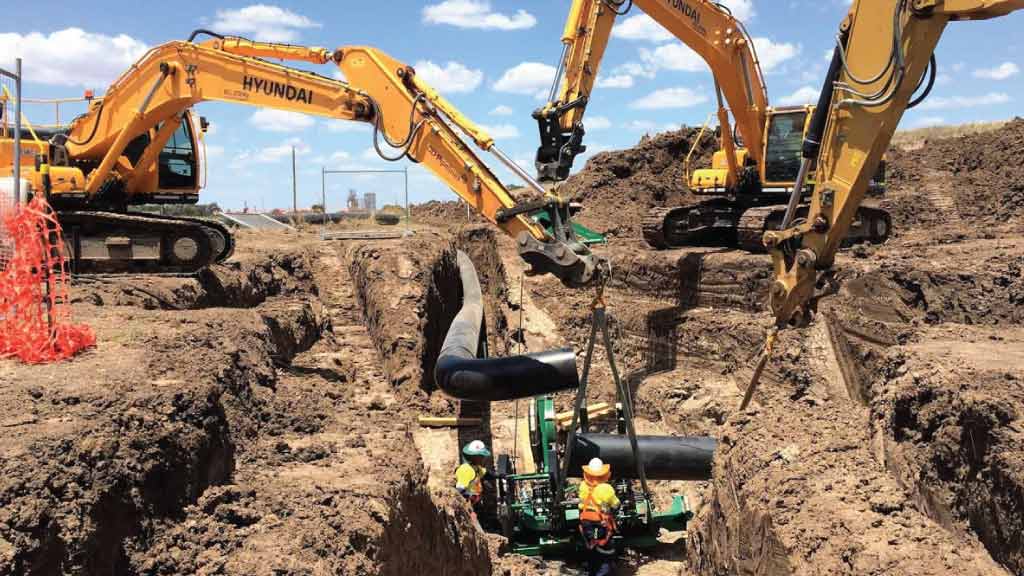
Are you wondering what Poly Pipe is? If you are involved in civil infrastructure, mining, or utilities, you’ve likely heard the term “poly”, but what exactly is it, and why has it become the industry standard over traditional materials like steel or PVC?
Also known as High-Density Polyethylene (HDPE) or simply PE, it is a durable, flexible thermoplastic polymer pipe. Renowned for its leak-free welded joints, chemical resistance, and 100-year design life, it is the preferred piping material for high-pressure water, gas, and slurry applications across Australia.
The History of Polyethylene Pipe
First developed in Europe and the United States in the early 1930s, low-density polyethylene was initially used as a coating for underwater cables during World War II. However, the high-density polyethylene (HDPE) technology used in modern pipes entered the market in 1951.
Poly pipe has been manufactured in Australia since the 1950s. It started as a small-diameter solution for rural irrigation, but over the past 60 years, its popularity has exploded. Today, its wearability, flexibility, and ease of installation make it far superior to alternatives such as PVC or concrete.
How It’s Made?
HDPE pipe is manufactured by extrusion. It begins with raw Polymer Resin (typically in the form of small pellets). These pellets are melted down, forced through a circular die (extruded) to form the pipe shape, stretched, and then cooled under a vacuum to achieve a perfectly rounded, consistent pipe.
Because it is derived from natural resin, it is highly flexible. It is also non-toxic, making it one of the most environmentally safe and sustainable potable water piping products on the market.
5 Key Benefits of Using Poly Pipe
As a lightweight, chemically resistant material, HDPE is incredibly versatile. Here is why project managers prefer it:
- Zero-Leak Joints: Polypipe is fully weldable (via butt fusion or electrofusion). You don’t have to rely on glue, mechanical joints, or rubber rings that degrade and leak over time.
- Exceptional Flexibility: The material is naturally bendable. This makes it easy to manoeuver on-site and allows the production of long, continuous lengths (up to 20 metres straight or in long coils), reducing the number of joints needed.
- UV Stability: Modern poly pipe is naturally UV-stable, making it ideal for Australia’s harsh, hot climate and remote mining applications.
- 100-Year Lifespan: Because it doesn’t pit, rust, or corrode, it boasts a design life exceeding 100 years in most environments, making it highly cost-effective over its lifecycle.
- Seismic Toughness: Because it is an elastic material, it can absorb ground movement. Following the 2011 Christchurch earthquake, HDPE became the most widely used material for rebuilding the city’s underground infrastructure.
PE80 vs PE100
The grade and density of polymer resins have improved significantly over time.
In Australia, early PE pipe products were classified as PE30, then PE50, and later PE80 (often referred to as MDPE – Medium Density Polyethylene).
Today, PE100 is the global industry standard for high-density applications.
| Grade | What it is | Best for |
| PE80 (MDPE) | Medium-density polyethylene — older generation resin | Lower-pressure applications, legacy systems |
| PE100 | Premium standard HDPE — maximum pressure capability and durability | General-purpose high-pressure water, gas, and slurry |
| PE100 RC | Rapid Crack Resistant resin — engineered to resist slow crack growth | Trenchless installations where the pipe drags against rocks or abrasive ground |
| Co-Extruded (White-Jacket) | Dual-layer pipe with a white outer sleeve that reflects sunlight | Australian conditions, as it reduces surface temperature and pre-installation thermal expansion |
At Advanced Piping Systems, we specialise in stocking and supplying premium PE100 and PE100 RC piping products.
Best Applications for Poly Pipe
Polyethylene pipe is used extensively across the heavy industry. Its combination of leak-free joints, chemical resistance and pressure capability suits it to a wide range of applications.
| Sector | Typical applications |
| Water infrastructure | Civil waterways, pressure water mains, sewerage systems, fire hydrant ring mains |
| Mining and processing | Slurry lines, process piping, pump station rising mains, tailings |
| Gas | Reticulation mains, distribution networks |
| Treatment and chemical | Treatment plants, chemical dosing, effluent management |
| Trenchless installation | Horizontal Directional Drilling (HDD), pipe-bursting, sliplining |
The Trenchless Installation Advantage
One of the most valuable applications is in trenchless technology, such as Horizontal Directional Drilling (HDD). Because of its strong welded joints and flexibility, long strings of poly pipe can be pulled underground through bored holes. This avoids the need for massive open trenches, drastically reducing traffic disruption in cities and minimising environmental impact in rural areas.
Proven for Municipal Water
A 2009 study by the Plastic Pipe Institute (PPI) and Jana Laboratories confirmed that the 100-year life expectancy for poly pipe applies to municipal potable water systems.
“One hundred- year service life exceeds typical expectations; fifty years is widely accepted as the usual benchmark. Polyethylene has been successfully used for water pipes… since the late 1950s due to its leak-free joints, durability, resistance to galvanic corrosion, and long-term cost-effectiveness.” — Tony Radoszewski, Executive Director of PPI.
Because of this overwhelming evidence, polyethylene is now the best-practice material for rebuilding urban waterways and replacing aging, failing infrastructure.
Need HDPE for Your Next Project?
If you would like to learn more about how Advanced Piping Systems can supply the right pipe and fittings for your next major project, contact our technical team today.
Contact us via the form on our website, or call 1300 362 229.

